
Breaking: A powerful 7.7-magnitude earthquake strikes Panama
10.10.2026 - 08:22 | Last Updated:
AA/İHA
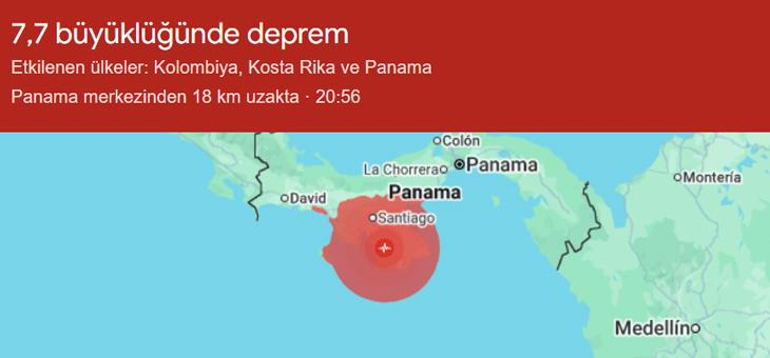
A powerful 7.7-magnitude earthquake that struck southern Panama caused widespread panic across a large area, including the capital, Panama City. Following the quake, which was recorded at a depth of 10 kilometers, a tsunami warning was issued for regions along the Pacific coast. President Jose Raul Mulino, who visited Penonomé—one of the cities hardest hit by the earthquake—said his country was facing a major disaster.
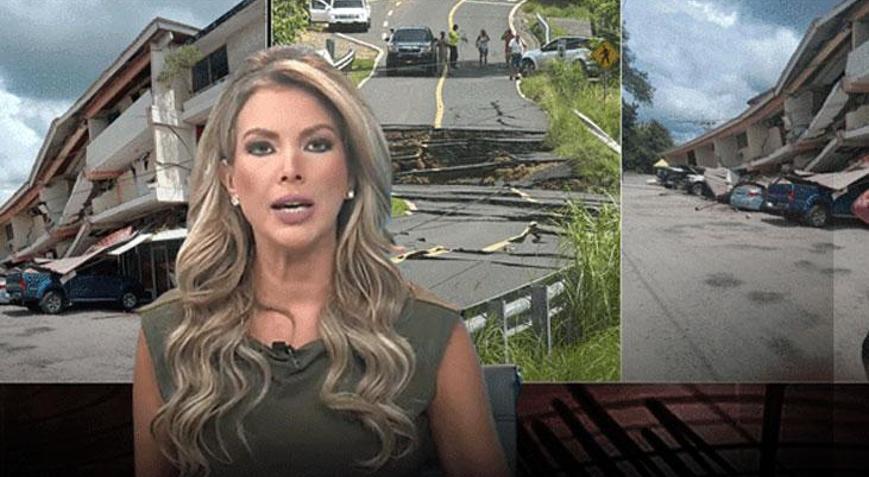
According to a statement from the U.S. Geological Survey (USGS), the 7.7-magnitude earthquake that struck the Pitaloza Arriba region near the southern tip of Panama was recorded at a depth of approximately 10 kilometers.
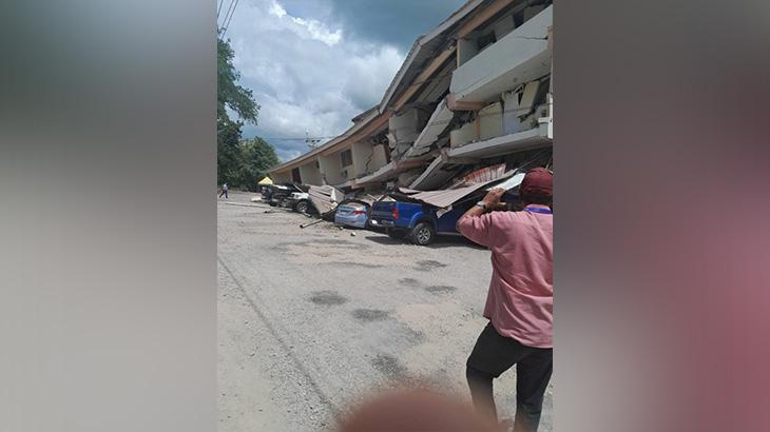
TSUNAMI ALERT IN THE PACIFIC
Following the earthquake, which was also felt in the capital, Panama City, a tsunami warning was issued for regions along the eastern Pacific coast. Initial footage revealed the severity of the earthquake.
PRESIDENT ISSUES STATEMENT
Panamanian President Jose Raul Mulino called on the public to remain calm in a statement posted on the social media account of the U.S.-based company X.
Mulino noted that relevant agencies continue to keep the public informed about the earthquake’s effects and emphasized that the earthquake should not be used to cause panic, fear, or chaos.
"THE DISASTER WE ARE FACING IS ENORMOUS"
Panamanian President Jose Raul Mulino stated that his country is facing a major disaster following the 7.7-magnitude earthquake that struck the southern part of the country.
Mulino, who visited Penonomé—one of the cities hardest hit by the quake—made remarks regarding the 7.7-magnitude earthquake that shook Panama.
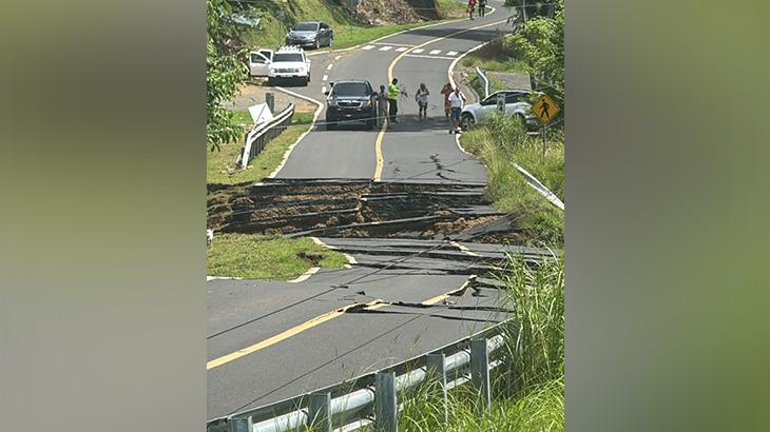
Noting that some roads had completely collapsed, Mulino said, “The disaster we are facing is massive. We have roads that have completely collapsed. For now, we are here; we’ll see—hopefully, weather conditions will allow us to travel to Tonosi, the epicenter of the earthquake,” he said.
Drawing attention to the rainfall, Mulino noted:
“Throughout this process, the Panamanian government’s full solidarity and support are on the ground. Everything needed in this situation—water, supplies for children and the elderly, and tents to shelter people—is being distributed. I have ordered the closure of all government agencies. The Ministry of Education has also suspended classes at all schools nationwide. We know that hospitals, churches, and a school have been seriously affected. Let’s see—let’s hope everything turns out for the best.”
Health Minister Fernando Boyd also noted that the most damage occurred in the provinces of Cocle, Los Santos, and Herrera.
Emphasizing that all access to the town of Tonosi in Los Santos province has been completely cut off, Boyd stated, “Since land access is impossible, we’re trying to figure out how to reach it by air.”
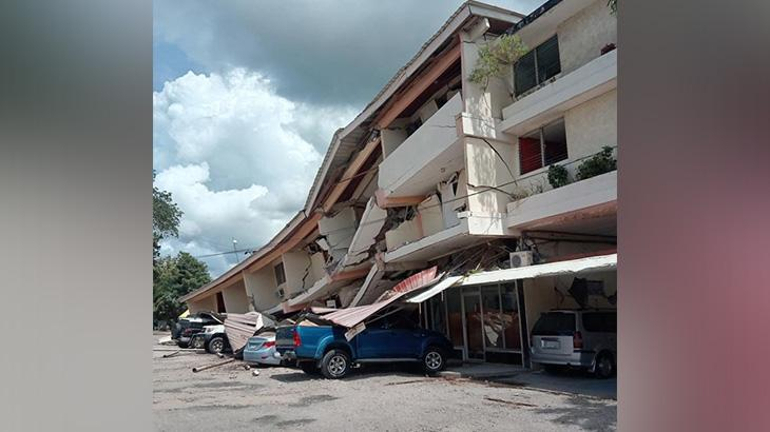
DAMAGE ASSESSMENT EFFORTS HAVE BEGUN
According to national media, local authorities and emergency response teams began damage assessment efforts following the 7.7-magnitude earthquake that struck southern Panama at 12:56 p.m. local time.
PEOPLE FLOCKED TO THE STREETS
Across Panama, people were rapidly evacuated from buildings, shopping centers, schools, and homes to open areas. Footage shared on social media showed thousands of people pouring into the streets and open areas, with damage visible in some buildings.
In the city of Penonomé, located in Coclé Province—which was hardest hit by the quake—structural damage was reported at the historic San Juan Bautista Cathedral, the governor’s office, and numerous other buildings in the city.
SOME STUDENTS INJURED
Panamanian Interior Minister Dinoska Montalvo reported that 15 students sustained minor injuries following the 7.7-magnitude earthquake in the southern part of the country.
In a statement to the press in Coclé Province, Montalvo provided an assessment of the 7.7-magnitude earthquake.
Emphasizing that 15 students were slightly injured at the Alberto Zuniga School in the city of Penonomé, located in the central part of the country, and that there were no fatalities at a collapsed hotel, Montalvo said that no missing persons had been reported nationwide and that search and rescue efforts were continuing uninterrupted.
Montalvo noted that homes, public buildings, churches, hospitals, and roads in various regions of the country had sustained damage in the earthquake, and that water treatment plants had also been affected.
Meanwhile, according to a statement from the U.S. Geological Survey (USGS), a 6.6-magnitude earthquake struck Panama, 8 kilometers northwest of Rio Grande.
The earthquake was recorded at a depth of 10 kilometers. The number of aftershocks following the earthquake in Panama has exceeded 95.
WAVES BETWEEN 1 AND 3 METERS HIGH MAY BE OBSERVED
The U.S. Tsunami Warning System issued a tsunami warning for certain coastal areas of Panama, Colombia, Costa Rica, Ecuador, Peru, Nicaragua, Guatemala, El Salvador, and Mexico for the three hours following the earthquake.
The warning also noted that there was a tsunami risk for the U.S. state of Hawaii in the Pacific Ocean.
While the Pacific Tsunami Warning Center (PTWC) announced that the widespread tsunami threat had ended, the University of Panama’s Institute of Geology reported that waves 1 to 3 meters high could be seen in coastal areas.
Authorities urged residents of Isla Canas, the southern coast of Los Santos, and the Veraguas coastal strip to move away from the coast and head to higher ground.
Meanwhile, the Panama Canal announced that operations were continuing normally following the earthquake.
FLIGHTS RESUME
Tocumen International Airport, which had suspended operations for safety reasons due to the earthquake in Panama, reopened to air traffic after a suspension of approximately two hours.
In a statement from airport authorities, it was reported that flights had gradually resumed following the completion of infrastructure and control tower safety inspections.
It was stated that the temporary suspension was implemented to prevent potential disruptions in the terminal infrastructure and to manage possible congestion in air traffic services.